Lighthouse Keeper

Keeping the lights on to guide you home

  • As for other matters, brothers and sisters, we instructed you how to live in order to please God, as in fact you are living. (1 Thessalonians 4:1). 

    There seems to be an epidemic in the modern church of Christians who think God is displeased with them. He’s not. He loves you and is the Good Shepherd (John 10)  and the Skilled Potter (Jeremiah 18:5) leading and guiding you into all He has for you. 

    In Thessalonians, the Apostle Paul offers encouragement to the church and declares that they are doing well and should just do what they are doing more and more. “We ask and urge you in the Lord Jesus to do this more and more”. (1Thessalonians 4:1). 

    What is the “this” that Paul is talking about? Basically abstain from sexual immorality, work hard, and love one another (He outlines these points in verses 1Thessalonians 4:3-13). 

    Perhaps this is what God is saying to you today: You got this. You are running a good race and God is proud of you. There’s no need for a big Damascus Road encounter, flashes of lights and anything radical to change in your walk. Just keep doing what you’re doing. 

    To add seasoning to the meal, Paul’s letters always include an encouragement to “love each other” (1 Thessalonians 4:9) and that’s about it. He is always building up and encouraging and not tearing down. This is the way of Christ. 

    If you walk away from church on a Sunday morning feeling boxed around the ears and that you aren’t doing enough for God (whatever that means) then shake it off and get back to basics. You may even want to find a new community of believers who build up and encourage as the Bible exhorts us to do (1 Thessalonians 5:11). 

    The Lord takes pleasure in those who fear him (Psalm 147:11). God is pleased with you +

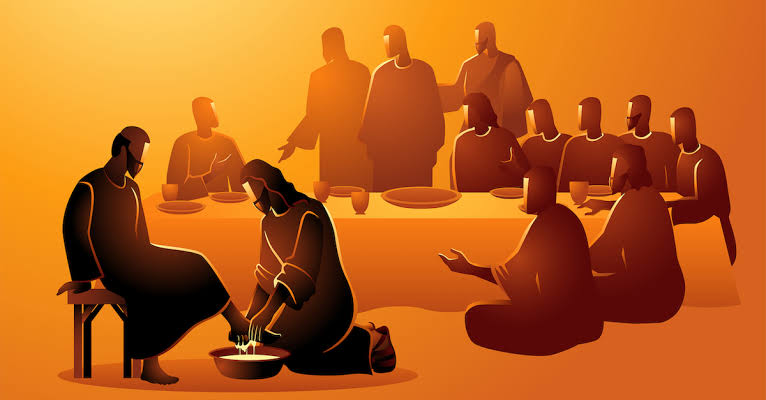
  • 3 Jesus knew that the Father had put all things under his power, and that he had come from God and was returning to God; 4 so he got up from the meal, took off his outer clothing, and wrapped a towel around his waist. 5 After that, he poured water into a basin and began to wash his disciples’ feet, drying them with the towel that was wrapped around him (John 13: 3-5)

    To abide with Jesus and let him wash us.

    Our little Martha brains (Luke 10) want to run around and fix everything. We dive into other people’s problems and offer complex, divine solutions for others that we are not able to offer for ourselves. We run God projects and save-the-world projects at the expense of letting Jesus wash our feet first.I was in Glebe, Sydney one Maundy Thursday before Easter (it’s an Anglican thing mainly the day before Good Friday).

    I was fascinated by a little stone church and the people meeting inside surrounded by candles. As I poked my head in to be a tourist and look at the church building, I noticed they were setting up for washing feet. A group of young people, no older than 30, were filling up white basins and gathering towels. They asked me to join so I instantly sat down and thought “Who’s feet should I wash first?”

    A young brown-haired woman asked me to take my sneakers off and bent down to start washing my feet. Like Simon Peter, I protested (John 13:6), embarrassed of my stinky Nikes. I wanted to be the one doing the foot washing. But (just like Jesus) the young woman persisted and put my smelly feet in the basin and soaped them up before drying my feet gently with a towel. I was completely humbled by the experience as the Scripture came to mind:

    “Unless I wash you, you have no part with me” (John 13:8).

    I talked to the young woman later and she had just been ordained as an Anglican Reverend. This was her first Parish in Glebe and she invited me back to the Easter services over the weekend (which I did attend–even though I’m Pentecostal not Anglican). It’s vital to always sit with Jesus and allow Him to wash our feet first before we have any part with the world. If we are unable to look simply at our own shortcomings and need for the mercy and grace of Jesus; we are unable to offer it to others. Abide and be washed…washed regularly by the love of Jesus +

  • The Promised Land- Colin McCahon 1948

    For no matter how many promises God has made, they are “Yes” in Christ. And so through him the “Amen” is spoken by us to the glory of God.(2 Corinthians 1:20)

    There’s no better way to learn the Word of God than to simply sit and read an entire book from start to finish. I sat down and read the Book of Jeremiah this afternoon and found myself in a faith crisis as I started to ponder “so am I in Babylon or am I in the Promised Land?”

    We all want to be in the Promised Land (Genesis 12:1)  or at the very least gearing up for a Jordan crossing (Joshua 3:14-17)  but I started to wonder if I was kidding myself and needed to brace myself for 70 years (Jeremiah 25) under King Nebuchadnezzar? 

    “Build houses and settle down; plant gardens and eat what they produce. Marry and have sons and daughters; find wives for your sons and give your daughters in marriage, so that they too may have sons and daughters. Increase in number there; do not decrease. Also, seek the peace and prosperity of the city to which I have carried you into exile. Pray to the LORD for it, because if it prospers, you too will prosper.” (Jeremiah 29:5-7)

    Jeremiah 29:5-7 gives instructions to the exiles from Jerusalem to build and to plant and pray for the prosperity of the Babylon kingdom. It’s going to be a while before you go back to your land. 

    If you turn on the news, it’s easy to think we are living in a modern Babylon (and many denominations teach that’s exactly where we are until the Second Coming in Revelation).

    As a Pentecostal, I take a more hopeful view, keeping in mind that we are this side of the Resurrection. Jesus has atoned for our sin and rebellion at the Cross and if you receive Jesus and are filled with the Holy Spirit, you can now claim Kingdom Come and the promises of the Bible. These promises include rest and peace and healing and freedom and no longer being separated from God. Yes there is warfare and battle for the Promised Land (as with the Israelites in Joshua) but please don’t lose sight of what Jesus has purchased for you and me at Calvary. 

    Wilderness is where you are not living the abundant life of John 10. You can still be a saved, believing Christian and have a wilderness or two as God repositions and centres you back into the Yes and Amen promises of the New Testament. 

    Smith Wigglesworth teaches that faith is not passive, but an active pursuit of God’s Word and commands and obedience to His will. Promised Land is achieved by claiming and standing on the promises of the Bible. Living in a state of victory and purpose in the present age is Promised Land. Yes- it can be here too even if there is darkness and Babylon around us.  Taking a deep dive into the Old Testament is always a wild ride but don’t forget, the tomb is empty or you might get tricked into thinking you, too, are in Babylon. 

  • It’s true that some are preaching out of jealousy and rivalry. But others preach about Christ with pure motives. They preach because they love me, for they know I have been appointed to defend the Good News. Those others do not have pure motives as they preach about Christ. They preach with selfish ambition, not sincerely, intending to make my chains more painful to me. But that doesn’t matter. Whether their motives are false or genuine, the message about Christ is being preached either way, so I rejoice. (Philippians 1: 15-18 NLT)

    I love this run of Scripture. Imagine if everyone in the body of Christ took this view of preachers. Instead, we waste energy and stir up discontent by finger pointing and accusing others of having impure motives. 

    The apostle Paul says “I don’t care—as long as Christ is being preached”. He even “rejoices” at the thought of it.

    Let’s be honest, there is a fair amount of performance in modern preaching (especially in Pentecostal churches) and I love it. I see no issue with using good and proven communication techniques to make the Gospel more digestible for the sheep. If you can engage and educate and lift up Jesus all at the same time, you’re OK with me. Jesus says to “feed my sheep, feed my lambs” (John 21:15-17) and if a little bit of sugar in the water helps the medicine go down then great. 

    We can get a bit snobby about certain well-known preachers and think that just because people are enjoying the message they are in some way being bewitched (Galatians 3) or given junk food. It’s not true. 

    CS Lewis said “A proud man is always looking down on things and people; and, of course, as long as you are looking down, you cannot see something that is above you.”

    When we rejoice in the message of the Gospel as Paul does we realise it’s not our place to assess the sincerity of the vessel. Chill out and celebrate the Word as Paul did.

  • The Lord your God is with you, the Mighty Warrior who saves. He will take great delight in you; in his love he will no longer rebuke you, but will rejoice over you with singing.” (Zephaniah 3:17)

    Yesterday after church we had ice cream in the sun to celebrate the start of summer. 

    It brought back a lot of memories for me of God’s faithfulness through the years. My first proper job out of university was as a grocery rep for Tip Top Ice Cream. I had 42 supermarkets to look after as an account manager and three merchandisers (the people who put the ice cream in the store freezers). I wasn’t a Christian but I was definitely in seeking mode and asking a lot of questions about what my life was about. I think I must have been about 22 years old. 

    As I drove around my 42 supermarkets I had a Bible in my glove box. A black ASV Bible -I had no idea about versions at that point I just got it from a secondhand book store for $2.  On my lunch breaks I would eat Subway in my car and read the Bible (keep in mind–not a Christian!) and somehow I got a copy of Hillsong “Hope” album and started playing that as I drove around. God had me right where He wanted me. Alone. Seeking. Singing over me and ministering to me. Just like Gideon and his private altar in Judges 6.

    One day, I remember sitting down in the back of a large Pak N Save carpark and it was pouring with rain. Experience taught me that you don’t want to go into a supermarket minus 25 degree celsius freezer soaking wet, so I was waiting for the shower to pass. I had just read John Burley’s book “7 Steps to Financial Freedom” and was stunned to find out that he was a Christian. I wanted to do what John Burley was doing (writing books, speaking, real estate investing) and I really looked up to people like him and Zig Ziglar (also a Christian). 

    I was thinking “Why are all these people I’m learning from Christians? Go away, leave me alone God! I want to do that too but I don’t want to be a Christian!”

    A still small voice then said to me “You won’t go anywhere without me”. 

    I was in my blue Mitsubishi Galant ice cream company car with my Subway and my Bible and my Hillsong CD and God had me cornered. I said “OK, I’ll go with you”. 

    I’m now 46 years old and still walking with the Lord. God knows the end of our stories and He is faithful to the end. I don’t know what lies ahead but I do know I was in church yesterday eating ice cream in the sun and for that I’m grateful. 

  • “You are my witnesses,” declares the Lord , “and my servant whom I have chosen, so that you may know and believe me and understand that I am he. Before me no god was formed, nor will there be one after me. (Isaiah 43:10).

    It sounds a bit old-fashioned to talk about “witnessing” nowadays. Everyone tries to lure people into their churches with good music, free meals, motivational preaching, and other lively programmes. 

    Being a witness for God is a simple business:

    “You are my witnesses”, declares the Lord, “that I am God”. (Isaiah 43:12)

    Tell people that God is real in your life. Tell people what God has done for you. Tell people that you go to church. No fancy church programme required just a simple “He’s real and let me tell you why I know that”. 

    The Oxford dictionary says that a witness “has knowledge of, or observation or experience”. 

    I used to work in the head office for a big supermarket chain. Standard water cooler chat on a Monday morning was always “What did you do over the weekend?”. 

    I would always say “Yeah nothing special just beach on Saturday and then church on Sunday”. 

    It would always be followed by an awkward silence and then “You go to church?! Did you get hit by lightning when you walked in?” Later in the week that same person would come back to my desk and say “Which church do you go to? I used to go to church…I haven’t been in years…I still sort of believe though…”

    A very easy, non-in-your face witness. 

    I planted the seed, Apollos watered it, but God has been making it grow. So neither the one who plants nor the one who waters is anything, but only God, who makes things grow. (1 Corinthians 3:6-9)

    Planting little seeds around in your daily life is all that co-labouring with Christ requires. (I Corinthians 3:9).

    In the New Testament, Jesus himself commissions believers to go out and witness to the ends of the earth:

    But you will receive power when the Holy Spirit comes upon you. And you will be my witnesses, telling people about me everywhere—in Jerusalem, throughout Judea, in Samaria, and to the ends of the earth.” (Acts 1:8 NLT).

    We can make very hard work of it and think we need to do some sort of CS Lewis apologetics on everyone we meet. It’s not necessary- and if Jesus is in your heart, He will naturally overflow in your conversations. You’ll be surprised where the little seeds of hope take you and others.

  • They will build houses and dwell in them; they will plant vineyards and eat their fruit. (Isaiah 65:21)

    I don’t know where the weird austere theology comes from but I’ve seen it posted on Instagram accounts and preached in churches:

    “A tree doesn’t eat its own fruit. You are blessed to be a blessing. Your blessings are for others not you”. It’s dreadful. A bizarre attack on grace and divine Providence that somehow the will of God is not for the individual Christian’s welfare. 

    In Isaiah 37:30 a prophecy is given about the attack from the Assyrians:

    “This will be the sign for you, Hezekiah: “This year you will eat what grows by itself, and the second year what springs from that. But in the third year sow and reap, plant vineyards and eat their fruit. (Isaiah 37:30)

    In the third year, the land returns to normal. Year three represents an end to the siege and restoration of the crops for normal harvesting and farming. 

    Planting vineyards and eating their fruit is often used to symbolise peace and security for the people of God. It is the correct order of things. 

    In the summer, I love to go to the farmer’s market here in town and buy some local produce. There’s a blueberry farmer and his wife who bring containers to sell and I really enjoy talking to them about their blueberry bushes and fruit.  The farmer is always giving me little tips and tells me to freeze them and eat them like sweets “I give them to my grandkids like that, saves their teeth”. He tells me that the blue colouring is good for my brain and has invited me out to the farm if I want to pick some myself. There is a natural overflow of joy and fruit and harvest from the farmer and his wife. They are proud of the work of their hands and the happiness and income it provides to them. Do they eat blueberries? Of course they do! They love eating blueberries and sharing recipes and tips with their customers. To say that the blueberry farmers shouldn’t eat the fruit of their crops is just nonsense. 

    Is the air that you breathe a blessing? Is it grace? Of course it is. Is it for you? Again, yes. 

    Your Father in heaven blesses you abundantly and the correct posture of a  Christian is to say “thank you” and receive from the generous hand of the Lord. 

    Saying it isn’t really for you is Puritan rubbish and not Biblical. Eat the fruit of your harvest. Yes it’s for you.

  • …and to put on the new self, created to be like God in true righteousness and holiness. Ephesians 4:24 

    Your main job as a Christian is to be an image bearer. We are made in the image of God (Genesis 1:27) so we always need to have in front of mind “is this something that Jesus would do or say or express?”

    Of course you can find this out by reading the Gospels and studying the ministry of Jesus on earth (Hebrews 1:3) and also through prayer (and reading the entire Bible which points to Jesus and the coming Messiah).

    I read a good quote the other day that said “you are an image bearer with work to do, not a work-doer with an image to maintain”. 

    So often in the church we see people who are outworking a character of what a good Pastor does or a preacher or a worshipper. There’s a lot of performance and not a whole lot of image bearing. As a result, people get locked onto a supposed call of God on their life and get fixed on the “doing” and forget about the “being”.

    How you treat and interact with people is very, very important. How you treat and interact with your family when nobody is  looking is even more important. If you have to steam-roll other people around you for your “ministry” then you’ve missed the point. That’s just charity and general do-gooding. And if you’ve spent any amount of time working in secular or Christian not-for-profit environments you will know they are extremely difficult places to work. Because everyone is saving the world! Everyone is being useful for the cause and trying to achieve some level of self-actualisation and meaning. There’s a whole lot of vanity and “look at me, I’m a good person” going on and not a lot of washing of the feet of your fellow workers. 

    • Get out of my way I am serving the poor. 
    • I don’t need to answer questions about my ministry because I’m serving the widows and orphans.
    • God has put me in charge so I don’t need to communicate with you about this project. 
    • God told me to do XYZ. 

    All of these things may be true and maybe God has told you to do the good works he has prepared in advance for you to do but how should you go about it? If you are abiding in Jesus He will be constantly pruning and renewing you into His likeness. The image bearer.  So the things we need to be always asking ourselves are:

    • Am I outworking what I’ve seen Jesus doing or a character that I’ve seen in church culture?
    • Am I preaching like TD Jakes because it’s cool (it is cool, I love TD Jakes) or am I being a vessel for God’s message to the church? Am I performing art Worship to be like Chris Tomlin and look spiritual or am I fixed on Jesus? (2 Timothy 2:20)
    • Am I concerned with the welfare of my flock or just how many people show up on Sunday? (John 21:15-17)
    • Did I respect the migrant worker at the supermarket and welcome them to my country (Exodus 23:9) or did I have a moan about a mosque being built in town? 

    The new self is the Jesus self, we are imitators of God (Ephesians 5:1). Copy Him, study Him and follow Him. 

  • He will judge between the nations and will settle disputes for many peoples. They will beat their swords into plowshares and their spears into pruning hooks. Nation will not take up sword against nation, nor will they train for war anymore. (Isaiah 2:4).

    We used to always joke about my friend Sarah’s Dad. 

    “He was in the real army, then the reservists, then the Salvation Army. He always has to be part of some sort of army”. 

    I think a lot of Christians are the same. The holy war that they are fighting, whether real or imagined, gives them purpose and makes people feel relevant in a world where it’s easy to feel insignificant. In the modern world, their energies translate into politics and Christian dog-whistling by political leaders ensures there’s a steady stream of outraged Christians that will go into battle for their nation or faith.

    There’s a lot of war and fighting in the Bible. There’s a lot of war and fighting in the world. However, the prophecy of Messiah in Isaiah 2 tells us He (Christ) will be the judge between nations and peoples and we will not train for war anymore. 

    Nation will not take up sword against nation. Wouldn’t that be nice?

    On this side of the resurrection, we have a picture of Jesus who did his battle in the prayer room (or garden)  of Gethsemane (Matthew 26:36).  He submitted to the divine will and redemptive plan of his Father God and didn’t take up arms against those who seized and beat him. It is the true dying of self. The bending of free will. Submission. (Matthew 16:24). 

    Believing that Jesus will judge between nations and peoples -and we can get on with farming and cultivating our lives with our ploughshares and pruning hooks- sounds simple but is difficult to do in reality. The emotions fire up. We sense injustice and disrespect. It is in our human nature to post those comments on social media and snip at people and moan and complain that our coffee is colder than we would have liked. Nations are still training for war and taking up swords against one another because individuals refuse to give up their arms and go farming. Imagine if we actually believed the promise of Isaiah 2:4 and cast our cares on the Lord and moved on? (Psalms 55:22, 1 Peter 5:7). 

    You can. I’m slowly learning how to (I don’t always get it right) and as a person of words it’s very challenging for me to not write that smarty pants reply or defend myself and my friends against schemes. But we must learn to. It’s the way of Jesus and we must breathe and submit to His perfect and pleasing will in our lives.  Join the non-combat forces. Back to the farm.

    We have a judge who sees and cares and knows. Trust Him. 

  • You intended to harm me, but God intended it for good to accomplish what is now being done, the saving of many lives. (Genesis 50:20)

    Going “no contact”. Cutting off people who don’t make you feel “emotionally safe”. Blame your parents. Blame your ex.  It all sounds very healthy and while I’m not condoning abuse, I think the current Tik Tok trend to obliterate people who don’t “meet my needs” is very self absorbed and toxic in itself. We have a loneliness epidemic and continually cutting people off who don’t go along with everything you ask and imagine is a surefire way to end up isolated. 

    We all have issues from our past and family/work/life contexts and Lord knows I have a long list of grievances should I choose to wallow in that. But I’m determined not to be a victim–mainly because it’s super disempowering and also because it makes the assumption that God somehow got my life wrong. 

    He is the author and perfecter of my faith, and life (Hebrews 12:2).  Keeping the pen in His hand and trying not to wrestle it off Him is a constant battle for me. I want to throw that person under the bus and get revenge and snub them at the supermarket. I want them to feel the pain they caused me or “trauma” as everyone on Tik Tok calls it.

    I really don’t think that Joseph in the book of Genesis would have chosen the horrific plot twists and dark nights of the soul that are part of his story. 

    Betrayed and sold by his brothers, accused of sexual assault by his boss’s wife, left to flounder in prison. We can look back at our lives and think “God… why did you let those things happen to me?” 

    It’s too easy to watch a Tik Tok influencer and think: “That’s it..I’ll go no contact with that person who hurt me. This will make the pain go away”. But it won’t. Seemingly old fashioned and dare I say Biblical concepts like compromise, mediation, patience, kindness, turning the other cheek and the biggie…forgiveness, don’t seem to feature on the 20 second videos. And I really think you’re trading off short term relief for long-term anguish. Joseph wept for his family (Genesis 43:30). He felt the emotional pain but he refused to take his eyes off God and his faithfulness and belief in the goodness of God gave him a heart to see the big picture. “The saving of many lives”. 

    I see people going on about “protecting the peace” when in reality they just don’t have the emotional maturity to navigate conflict. See things from another perspective. Apologise. Look at the speck in your own eye. Forgive. There is enough war and conflict in the world– your peacemaking might just be the testimony that someone else needs to heal their relationships.

    God doesn’t make mistakes in our story.